DESK / ORIGINAL DESIGN
Two-pen rest
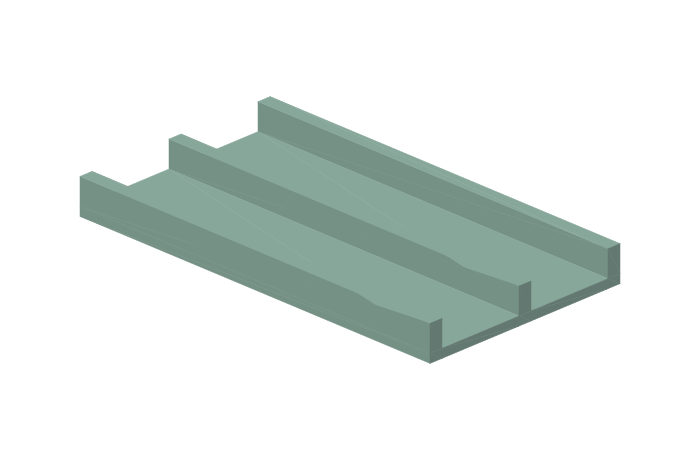
Two shallow channels to stop pens wandering across your desk.
70 × 38 × 8 mm
Version 1.0.0 · millimeters · single-color PLA
Place it on the plate
Print base down, channels facing up. Each open-ended channel is 15.4 mm wide; measure your pens first. This is a shallow rest, not a retaining clip or vertical holder.
Suggested starting points
For PLA and an actual 0.4 mm nozzle: a compatible 0.20 mm layer-height process, 3 wall loops, 4 top and 4 bottom shell layers, 15% infill. Start base-down with supports off and no brim, then inspect the slice. These are suggestions, not certified presets.
Select the actual Bambu Lab P2S, installed nozzle, build plate and filament presets in Bambu Studio. Use their temperature and speed defaults. No AMS is required. Check dimensions, first-layer contact, shell closure, overhangs and all warnings before initiating a print yourself.
Full beginner printing guide →Use it thoughtfully
For light, non-critical organization or learning only. Not for food, heat, electrical, medical, structural, weapon or safety-critical use. Follow the printer manufacturer's safety and ventilation guidance.
Make it your own
Adjust width for your pens. Channel width must remain at least 6 mm; there is no friction-fit promise.
| Parameter | Default | Allowed range |
|---|---|---|
| length | 70 mm | 30 to 160 |
| width | 38 mm | 20 to 120 |
| height | 8 mm | 4 to 20 |
| wall | 2.4 mm | 1.6 to 5 |
| base | 2 mm | 1.2 to 5 |
| channels | 2 count | 1 to 5 |
Additional relationship checks apply. Model notes describe the default dimensions; re-check clearances for variants.
python -m tools.cli parameters pen-rest
python -m tools.cli build pen-rest --output build/my-variant
Learn the AI-assisted creation workflow →
What we checked
- Generated: yes
- Software checks: passed on the exported STL
- Slicer review: not performed
- Physical print: not performed
68 triangles. Closed, consistently wound edges; finite, nondegenerate faces; connected mesh; positive volume; Z=0 placement within the P2S build envelope. These limited checks do not prove printability or detect every possible geometry defect.
STL SHA-256: 8d10a3f9b76f2d74514c5d39fdc403b8024486ab5f2b7bc8be79ac9bb579943b
Variant ID: 0cc6c2f4cf4d64fde0a971fc117bcb2d163e6f346257c2504b9a44e53ce34f30
Suggested recipe: p2s-pla-0.4-v1 (unverified). Exact design-source hashes and separate evidence scope are in the passport.
Share a print result: successes and failures welcome →
Include model version, variant ID, STL hash and actual settings. Public reports are observations, not automatic certification.
Original design by OpenPrintLab contributors. CC BY 4.0; keep attribution and indicate changes. Tooling code has a separate MIT license.